

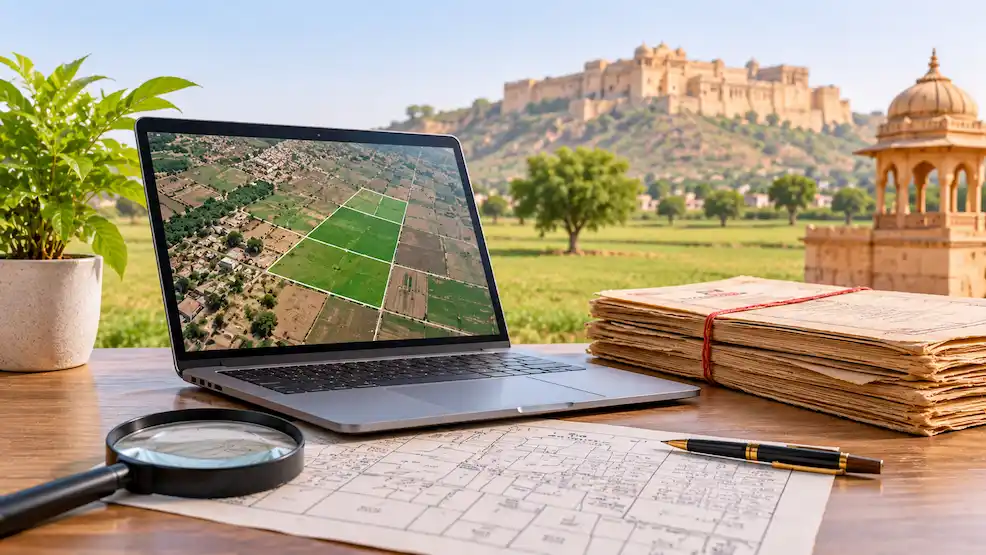
Most land disputes start long before anyone files a case. Somebody buys on the seller’s word, nobody reads the revenue paper, and years later it turns out the recorded holder was a different person.
Rajasthan land records are the revenue department’s papers on who holds a piece of land, how much of it, and how that changed over time. Three terms keep turning up in them: jamabandi, khasra and mutation. If you understand these, you can read a record yourself and notice trouble before you pay a token amount.
This guide explains each term in plain words. It then walks through Rajasthan land record verification on the state portal and covers what farmland buyers should check in Naugaon land records, in Alwar district.
What are Rajasthan land records and who maintains them?
The Revenue Department keeps them. They list holdings, plot numbers, area and transfers. The village patwari makes the day-to-day entries. When a transfer is reported, the patwari writes it into the mutation register and gives a receipt, and a revenue officer such as the tehsildar then looks at the case.
Much of this is online now. The Apna Khata (e-Dharti) portal lets you view the jamabandi, download copies, search by owner name, khata or khasra number, open cadastral maps (Bhu Naksha) and track mutation applications.
What is jamabandi in Rajasthan?
Jamabandi is a village’s record of rights (ROR). Rajasthan uses it directly as that record, which is why lawyers, banks and buyers all ask for it first. A Jamabandi Rajasthan extract lists the khatedar (the recorded holder), their share, the khasra numbers and the area.
Nakal just means copy. A “jamabandi nakal” is a copy of the record for one khata.
A simple example
Take a made-up case. A seller offers you two bigha, and the jamabandi shows two khatedars with equal shares. He can’t sell the whole plot alone, because the co-holder has to be part of the deal. You would only find that out by reading the record.
What is a khasra number, and how is it different from a khata number?
A khasra number identifies one parcel in a village. A khata number is an account number that groups everything one holder owns. A khata can cover several khasra numbers, and a single khasra can be shared by several khatedars.
Your sale deed has to quote the right khasra number and area. If the deed, the map and the jamabandi disagree on it, ask the seller why before any money moves.
What is mutation (namantaran) in Rajasthan?
Mutation updates the revenue record after land changes hands by sale, inheritance, gift or partition. Land mutation Rajasthan procedure sits under the Rajasthan Land Revenue Act, 1956, and Section 133 covers how a transfer is reported and entered by the patwari.
A mutation entry only updates the revenue record. It does not decide who owns the land. Courts have called these proceedings summary in nature, and title disputes go to the civil courts. So you want a registered sale deed and a clean mutation history together.
How the key terms compare
The table sums up how these terms fit together.
| Term | What it tells you | Why it matters to a buyer |
|---|---|---|
| Jamabandi | Record of rights: khatedar, share, khasra numbers, area | Confirms who the recorded holder is |
| Khasra number | Identifies one plot in a village | Must match the sale deed and the map |
| Khata number | Account grouping a holder’s land | Helps trace the seller’s other holdings |
| Mutation | Entry updating the record after a transfer | Shows whether earlier sales were reflected |
| Nakal | A copy of the record | The document you carry to a lawyer or bank |
How do you check Jamabandi Rajasthan online?
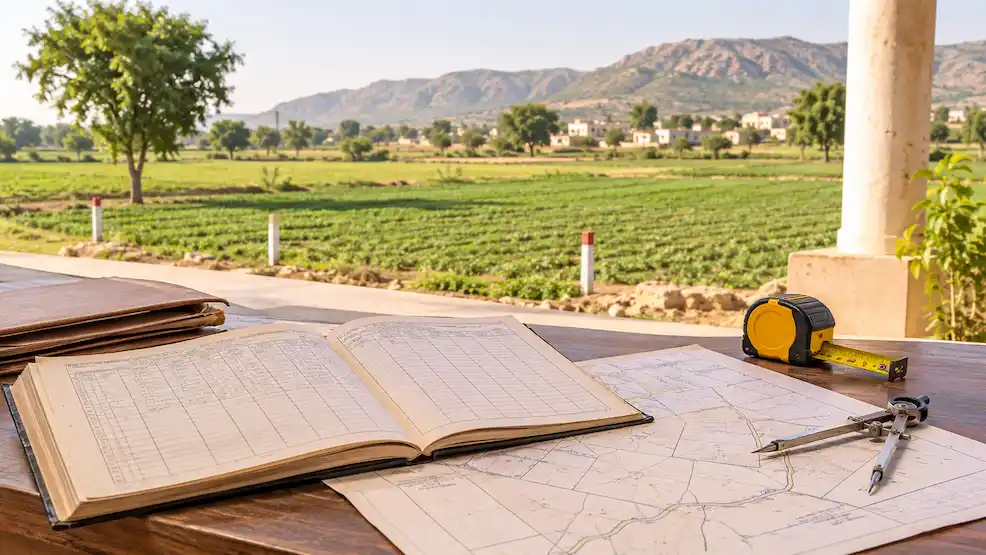
Step-by-step process
- Open the Apna Khata portal. Recent guides give the address as apnakhata.rajasthan.gov.in and say the older raj.nic.in address no longer works. Reach it from the official Rajasthan government site, because lookalike pages exist.
- Pick the district, tehsil and village.
- Search by khasra number, khata number or owner name.
- Open the nakal, then download or print it.
Searching Jamabandi Rajasthan records by owner name helps when you don’t know the khasra number yet.
Fees and validity of online copies
Rajasthan land records are generally free to view online. Certified or e-signed copies may cost a small fee, and guides disagree on whether a plain online copy works for every official purpose. Ask your bank, registrar or lawyer which version they want. The portal is a good first step in Rajasthan land record verification, but if anything looks off, ask the tehsil or patwari office to confirm it.
Land ownership verification Rajasthan: a buyer’s checklist
The online copy covers only part of the job. Real land ownership verification Rajasthan buyers can rely on means checking it against everything else the seller has shown you.
What to check
- Match the names. The seller should be the recorded khatedar, and the ID should agree.
- Check the shares. If there are co-holders, their participation matters.
- Compare the khasra number and area across the jamabandi, the map and the sale papers.
- Read the mutation history. Gaps can point to informal sales.
- Look at caste-based restrictions. Section 42 of the Rajasthan Tenancy Act, 1955 restricts transfer of land held by Scheduled Caste and Scheduled Tribe members to people outside those groups, and courts have examined mutations built on such sales.
- Confirm the land use. If you plan anything beyond farming, ask a lawyer whether conversion is needed.
- Visit the site, walk the boundary and talk to the neighbours.
- Have a local property lawyer review the papers before you pay.
Documents worth asking for
Ask for the latest jamabandi nakal, the sale deed and earlier deeds in the chain, any mutation receipt or order, and a Bhu Naksha extract of the plot. If a seller hesitates to share these, take note.
How does land mutation Rajasthan work after you buy?
The process
- The sale deed is registered.
- The transfer is reported for mutation. The patwari makes an entry and issues a receipt.
- A revenue officer examines the case.
- Once an order is passed, the jamabandi is updated.
You can also apply and track status on Apna Khata with your application number, khasra number or khata number.
Why you shouldn’t delay
Say a buyer registers a sale in March and never follows up. Years later the jamabandi still shows the seller, and if the seller dies, the heirs may appear as the recorded holders. The buyer holds a registered deed against a record that says otherwise. Even without that, an outdated record gets in the way of loans and resale. Filing for land mutation Rajasthan soon after registration keeps things tidy.
Naugaon land records: what farmhouse buyers should check
Naugaon in Alwar district is a familiar name for people looking for farmhouse land within reach of Delhi NCR. Many such plots are agricultural land, so the revenue record carries the deal.
Points to verify
When you go through Naugaon land records, check these points:
- Pick the right village and tehsil on the portal. Similar village names exist across the state.
- Confirm that the khasra number in the offer matches the jamabandi, and that the portion being sold actually sits inside it. If a larger khasra has been divided, ask how.
- Count the khatedars and look at their shares.
- Ask for proof of mutation for each earlier transfer.
- Ask the seller or developer for the full chain of title, not only the latest deed.
Doing this before you haggle over price costs far less than sorting out a title problem later.
Common mistakes to avoid
- Relying on a photocopy without matching it to the online record
- Ignoring co-owners’ shares
- Treating mutation as proof of title
- Skipping mutation after the purchase
- Using unofficial websites for Rajasthan land record verification
- Misreading entries because names are spelled differently. Ask the patwari office to clarify instead of guessing.
Conclusion
The jamabandi shows who holds the land and the khasra number shows which plot it is. The mutation history tells you whether the paperwork kept up with earlier sales. Reading Rajasthan land records takes some patience, but it is cheap protection for what is usually the biggest payment a family makes.
Before you pay, complete Rajasthan land record verification, work through the land ownership verification Rajasthan checklist above, and file for land mutation Rajasthan right after registration. If you’re looking at farmland and want someone to go through Naugaon land records with you, send our team the khasra number and we’ll help you read it before you decide.
FAQs-Rajasthan Land Records
It is a village’s record of rights. It lists the recorded holders, their shares, the khasra numbers and the area.
Viewing is generally free. Certified or e-signed copies may carry a fee, so check the current charge on the portal or at an e-Mitra kiosk.
Search by owner name on the portal. You can also check old land papers or ask the village patwari.
It depends on the type of copy and what you need it for. E-signed copies are generally described as suitable for official use, while plain online copies are often treated as reference copies. Confirm with the office asking for it.
No. It updates the revenue record. Title questions are decided separately, and disputes go to the courts.
You can start online. Cross-check anything doubtful with the tehsil or patwari office, and inspect the land yourself.
No. Add a site visit, a review of earlier deeds and a lawyer’s opinion.