

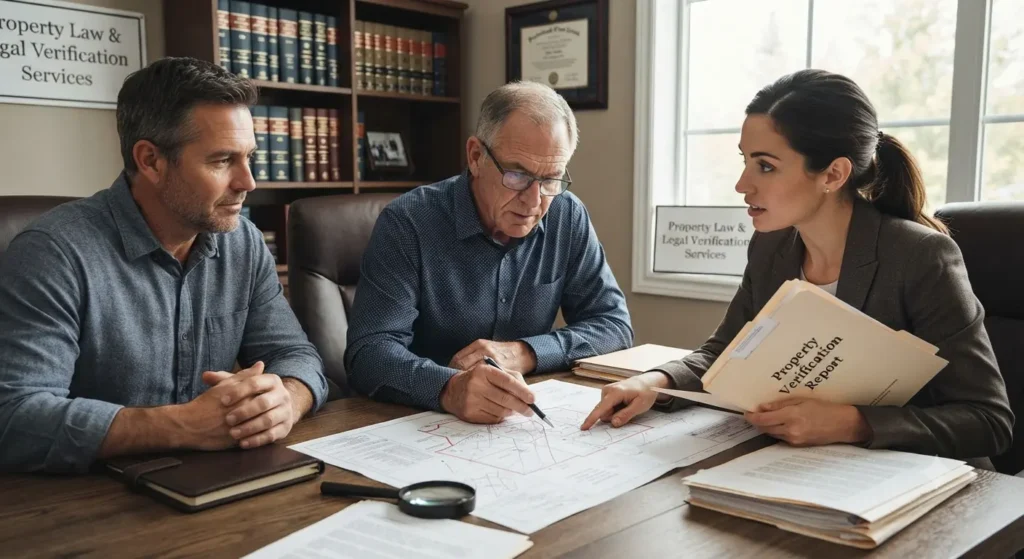
Land is one of the most critical financial decisions that one can make. There is a certain amount of planning that needs to be done and a good deal of research that needs to be conducted for any of these four grand categories of development: house construction, farmhouse development, business creation or business holding as a long-term investment. Apart from location, price, road connectivity, and future development, legal verification is one of the most crucial aspects before purchasing land.
There are numerous factors that many buyers take into account, including the appeal of the offer, the area and the anticipated returns. But failing to do so may result in ownership conflicts, monetary losses, building limitations, or complicated and extended legal proceedings. Even if a property appears to be ideal, it’s important to verify legal status before making any investment decisions.
Legal Verification Of Land – What It Is?
The legal verification process involves reviewing land ownership, government documents, approvals and the legal status of a property to make sure that the land is safe to purchase.
This is typically done by a competent property lawyer or legal expert who reviews the records and pinpoints any risks. Its purpose is to ensure the seller has the legal authority to sell the land and the buyer has the legal authority to get a legally valid and transferable interest in the land.
The following types of checks might be involved with legal verification:
- Documents of ownership and title
- Record of previous sales and transfers
- Encumbrances and outstanding loans include the following:
- Land-use classification
- Government permissions/approvals.
- A series of revenue records have been used as a source for property boundaries.
- Any cases or conflicts which are pending in court.
- Limits on land sale or development.
Details of documents and procedures may vary by type of transaction, land category and state.
1.Confirms the Seller’s Ownership is in force.
Legal verification of land is one of the main reasons for legally verifying land, to check whether the person selling the land is the actual owner of the land.A seller may not have full rights to something in some instances. The land may be jointly owned, passed down through generations, be part of a family disagreement or may be registered in another person’s name. It can also be circumstances where a person wants to sell property but hasn’t received permission from everyone who owns it.A proper title search will assist in determining the title history and find those who have rights to the property.Potential purchasers should review the relevant title deeds, the documents from any previous transactions, inheritance documents (if applicable), and receipt records from the authorities or revenue documents. When several individuals are owners, the necessary consents and signatures are to be checked.
A verbal agreement and a seller’s assurance of ownership is not the same as the legal proof of ownership.
Financial losses can be significant when you’re the victim of land-related fraud. It is possible that unscrupulous people might try to sell the same property to several people, forge documents, have false ownership, or sell land that is not theirs.
2.Guards Buyers against fraud and duplicate sales.
These risks can be minimised by verifying the seller’s paperwork with the appropriate official documents, using legal verification. It can also show inconsistencies in names, plot numbers, survey information, and transactions.The buyer should not only look at photocopies, brochures, or documents given to him/her by the seller. A system of records should be verified through the relevant government departments or official land-record systems where possible.Doing this, before paying a significant token sum, can help reduce incurring serious complications later.

3.Is able to locate existing loans and legal encumbrances.
You can have monetary or legal liabilities on a property. They are usually referred to as encumbrances.
For instance, land could have:
- The best type of mortgage or bank loan is…
- A registered charge
- A court-ordered restriction
- A controversy regarding ownership
- A negotiated watermain agreement that has been completed.Existing watermain agreement negotiated.
- Other claims that are enforceable under law.
These conflicts can cause problems for the buyer if they are not discovered prior to the purchase of the property, and can make it difficult for the buyer to get clear title or to enjoy the use of the property as intended.
A lawyer will be able to look at the encumbrance records and registration records that are relevant to the case as well as other sources to determine what may have a claim. If there is a loan, the purchaser should make sure that it is cleared up and that all release papers are handed over before the purchase is finalized.
4.Ensures That Land Use And Development Permits Are achieved
Not all land is suitable for all uses.
A plot can be used for agriculture, housing, business, forestry, or be located in another land use type. Some land types may be subject to development restrictions under local laws, such as construction, subdivision or commercial use.Local laws may also apply restrictions to certain types of land, including construction, subdivision or commercial use, or the development of farmhouses.
Buyers interested in farmland, farmhouse plots, or land by developing corridors should also consider this.
A buyer, for instance, may acquire farm property intending to build a big farm home. However, the local regulations may need to specify permits, land-use conversion or restrictions to be followed in order to allow construction to start.
Therefore, it is important that the law be verified to ensure that:
- The existing land use classification system
- Whether the proposed use is lawful or not;
- Determine if conversion is required or if change of land use is required.
- If construction permissions can be obtained.
- Whether local development regulations impose restrictions.
The beauty of a site does not necessarily imply that the property is suitable for the buyer’s use.
Corrects income and property records.
Land revenue records are important for determining land details. Records may contain documents like Jamabandi, Khasra details, Khatauni, mutation entry or other official land records depending on the state.
These documents can help verify information such as:
- An owner or tenure holder that was recorded.An owner, or tenure holder, that was recorded.
- Survey/ Khasra number
- Land area
- Character of the land and its type.
- Mutation history
- Revenue-related information
It’s important to remember though that mutation and revenue entries do not necessarily constitute good title. They should be considered in conjunction with registered title documents and other documents/evidence that are relevant.
Official maps and records should also be consulted for physical boundaries. Document mismatch with site can pose encroachment, access or neighbour’s land issues.
If needed, a professional survey will be useful to establish the plot location and size before the purchase is completed.
5.Helps Identify Potential Court Cases and Disputes
When a property is the subject of a trial in court, it can trigger a lot of stress and financial anxiety.
Conflicts can occur with family members or fellow owners, neighbors, developers, lenders or government bodies. Disagreements can be related to boundaries, access roads, ownership, inheritance or land-use rights.
Legal Verification plays a crucial role in determining potential litigation and restrictions based on relevant records and legal queries. A property lawyer will be able to make the assessment of the land and the information available in court whether or not it is involved in any dispute.
Buyers should be wary if a seller doesn’t show them the documents, doesn’t give a clear explanation, or rushes them to finalize the purchase.
Buying land is preferable when the law is clear and not when it is uncertain and may be tied up in litigation for years.
6.Asserts access roads and other property rights
A valid ownership document may have legal issues despite having been issued.Even though a valid ownership document has been issued, it might have practical legal issues.
In the case of a parcel without a legal approach road, for example, or access requiring crossing over another parcel, access may not be possible. Easements, drainage, electrical lines, water rights or shared access may also be problems.
These are particularly significant when land is in rural areas, gated farm communities and in developing areas.
The buyer needs to check following before purchasing:
- Whether the plot is accessible by law for road access or not.
- Whether approach road recorded or authorized
- If the access is dependent upon the third party’s land.
- If any easement or right of way exists, what it is
- If the proposed infrastructure has all the necessary approvals.
It is location and advertised price independent of how difficult it is to access a property legally, and thus how useful it will be, or how easily it might be resold.
7.Avoids issues in registration and resale.
The purchase of real estate is not complete after only the agreement is signed and money paid to the seller. The transaction has to be executed in a legally mandated process with appropriate documentation, if applicable.
Registration may be delayed or complicated if ownership records have errors, if the seller does not have authority or if the transaction is not in accordance with applicable restrictions.
Legal verification can help the buyer to clear these issues prior to preparing the sale deed.
Easy resale in the future, too, thanks to clear documentation. Prospective buyers and their attorneys will do their own due diligence when a buyer eventually wants to put his or her name on the deed. Without records, if there is a dispute, or if someone is unsure who the owner is, the buyer may not be as confident and will not proceed with the transaction.
Therefore, proper legal verification provides great value not only when buying land but also in safeguarding the future marketability of the land.
8. Reduces the Risk of Financial Loss
Land purchases often involve significant savings, loans, and long-term financial commitments. A small mistake during the initial stage can result in large expenses later.
Buyers may have to spend money on litigation, document correction, boundary disputes, loan settlement, or obtaining approvals that they did not anticipate.
Legal verification requires an upfront investment in professional advice and document review. However, this cost is generally small compared with the potential loss associated with purchasing disputed or unsuitable land.
A careful buyer should consider legal due diligence an essential part of the investment budget rather than an unnecessary expense.
Essential Documents to Check Before Buying Land
The documents required depend on the property and the state in which it is located. A preliminary checklist may include:
| Document or record | Why it matters |
|---|---|
| Registered title deed | Helps establish ownership and transfer history |
| Previous sale deeds | Helps trace the chain of title |
| Encumbrance certificate or relevant records | Helps identify registered claims and transactions |
| Jamabandi or other revenue records | Provides official land and ownership-related details |
| Khasra or survey records | Helps identify the parcel and its recorded area |
| Mutation records | Shows changes recorded in revenue records |
| Land-use documents | Helps confirm permitted use |
| Approved layout or development permissions | Important for plotted developments |
| Tax or revenue payment records | Helps identify outstanding dues where relevant |
| Court and dispute records | Helps identify potential litigation |
| Access and boundary documents | Helps confirm practical and legal usability |
This checklist is a starting point, not a replacement for a property-specific legal investigation.
Common Mistakes Buyers Should Avoid
Several mistakes can make a land purchase risky:
Relying Only on the Broker
A broker may provide useful market information, but buyers should independently verify legal documents. Marketing claims should never replace professional due diligence.
Paying Token Money Too Quickly
Buyers should avoid making substantial payments before reviewing the property’s legal status. Any advance should be governed by a properly drafted agreement with clear conditions.
Assuming Mutation Means Clear Title
Mutation is an important revenue record, but it does not by itself prove complete ownership. The title chain and supporting legal documents must also be examined.
Ignoring Land-Use Restrictions
A plot may be advertised as suitable for a farmhouse, residence, or commercial project without having all the required permissions. The buyer must verify the intended use independently.
Skipping Professional Legal Advice
Land laws, registration requirements, and local restrictions can be complex. A qualified property lawyer can identify issues that a buyer may overlook.
Final Thoughts
Buying land can be a valuable long-term investment, but the quality of the investment depends on more than location and price. Legal verification is the foundation of a secure land purchase.
From confirming ownership and checking encumbrances to verifying land use, boundaries, access, and development permissions, every legal detail matters. Proper due diligence can help buyers avoid fraud, reduce financial risks, and make more informed decisions.
Whether you are purchasing agricultural land, a farmhouse plot, residential land, or a parcel for future development, never rush into a transaction without understanding its legal status.
Before you invest your money in land, invest time in verifying its documents. A legally sound property is the first step toward a secure and confident investment.
Frequently Asked Questions
Everything you need to know about why legal verification is essential before buying land.
Why is legal verification essential before buying land?
Legal verification is essential because it confirms clear ownership, ensures the land is free from hidden debts, mortgage claims, or legal disputes, and verifies that the property complies with local zoning and urban planning regulations.
What are the major risks of buying unverified land?
Buying unverified land exposes buyers to severe financial and legal risks, including property fraud, multiple sales of the same plot by fraudulent sellers, hidden government acquisition notices, and long-standing ancestral court litigation.
What is a Title Deed and why do I need to check it?
A Title Deed is the foundational legal document proving who owns a property. Checking it ensures that the person selling the land has absolute legal rights to transfer the ownership and that there are no co-owner disputes.
How does an Encumbrance Certificate (EC) help during land purchase?
An Encumbrance Certificate provides a detailed record of all registered transactions, mortgages, or financial liabilities tied to the land over a specific period, confirming that the property is completely free from monetary encumbrances.
Can land zoning laws affect my ability to build on the property?
Yes. Legal verification ensures the land is zoned for your intended use (e.g., residential, commercial, or agricultural). Buying agricultural land without checking conversion laws can prevent you from legally constructing a building.
Why is verifying survey numbers and boundaries crucial?
Verifying survey numbers with a licensed surveyor ensures that the physical dimensions and boundaries of the plot match official government maps, preventing future boundary disputes with neighboring landowners.
What is a legal title search report and who should prepare it?
A title search report traces the ownership history of the land, typically spanning 30 years. It should ideally be prepared and verified by an independent advocate specializing in real estate law to catch hidden loopholes.
Does legal verification help in securing bank loans?
Banks and financial institutions strictly require clear legal documentation, approved titles, and comprehensive clearance certificates before approving a land purchase or construction loan.
What role do property tax receipts play in legal verification?
Up-to-date property tax receipts prove that the previous owner has regularly paid dues to local municipal authorities and serves as secondary evidence of continuous legal possession.
How can I protect myself from fraudulent power of attorney (POA) sales?
If a property is being sold through a Power of Attorney holder, legal verification ensures the POA is authentic, legally registered, and that the principal owner is alive and has explicitly granted rights for the specific transaction.