

Ask ten investors about the 3-3-3 rule land investment approach and you’ll hear ten slightly different answers. There’s a reason for that. Unlike the 1% rule for rentals, this one isn’t an official formula. It’s a rule of thumb, and it becomes genuinely useful once you pin down what it means.
Quick answer: the 3-3-3 rule is a checklist for buying land. Run three checks before you buy, add up three costs before you commit, and line up three exit routes before you sign. It’s designed to stop the three mistakes that sink most first-time buyers: falling for a view, skipping the paperwork, and having no plan for getting the money back out.
This guide walks through each part, explains how it fits with the wider 3-3-3 rule in real estate, and shows you how to invest in land with it, one plot at a time.
What exactly is the 3-3-3 rule?
Search the phrase and you’ll find a few versions. Some blogs use it for budgeting, others for holding periods. None of them is a legal standard or an industry regulation, so treat it as a mental model, not a law.
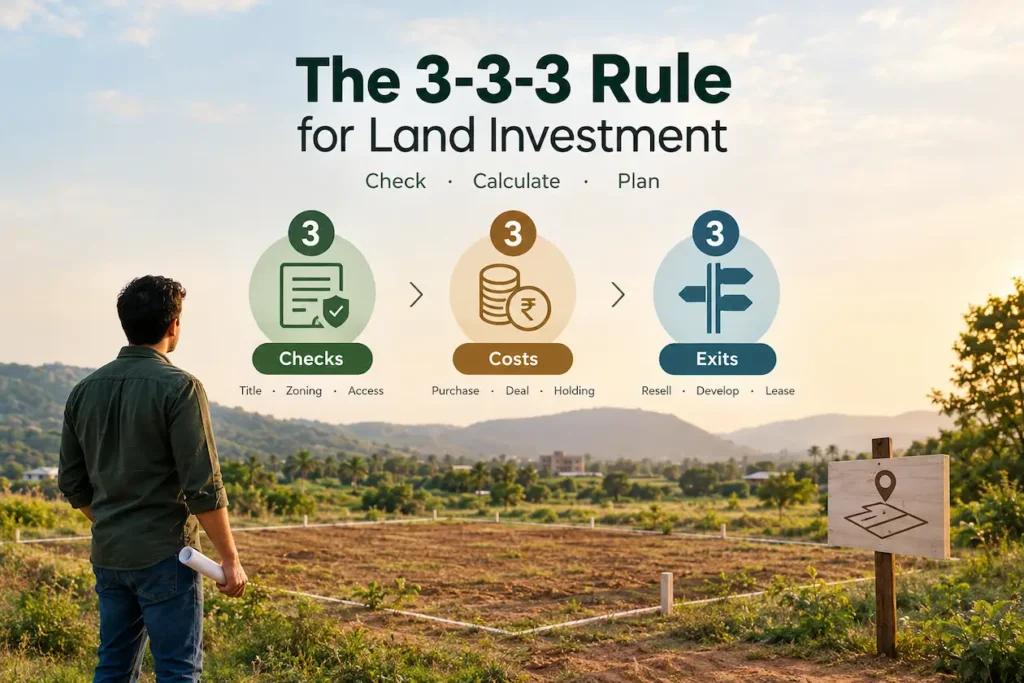
The version that works best for land splits your decision into three groups of three:
- Three checks before you buy: title, zoning and access
- Three costs to total up: purchase, deal and holding costs
- Three exits to plan: resell, develop, or hold and lease
If a plot can’t answer all nine questions, it isn’t ready for your money. That’s the whole idea. Used as a 3-3-3 rule land investment checklist, it’s short enough to remember during a site visit and strict enough to catch problems early.
Why land needs its own rules
A flat or a rental house gives you something to inspect and, usually, rent to collect. Raw land gives you neither. Your return comes from appreciation, development or a future sale, and none of those arrives on a fixed schedule. Land is also slow to sell, so one bad purchase can lock up your capital for years.
That’s why the best land investment rules tend to be unglamorous. They’re about verifying things, not chasing hype. It’s also why formulas built for rentals, such as rent-to-price ratios, don’t carry over neatly. The 3-3-3 rule in real estate that people borrow from property investing needs a land-specific version, because a plot has no tenant and no monthly income to measure.
The first 3: checks before you buy
The first part of the 3-3-3 rule land investment model is about legal and physical safety. Three things decide whether a plot is even worth discussing.
1. Clear title
Confirm the seller actually owns the land and has the right to sell it. Ask for the sale deed, the earlier ownership documents and the latest land record extract. In Goa, for example, that means the Form I & XIV record, which shows ownership and occupancy details. Check for loans, disputes or pending court cases against the land. A property lawyer is worth paying for at this stage; it’s the cheapest protection you’ll buy.
2. Zoning and land use
What the land is classified as decides what you can do with it. Agricultural, orchard, settlement, no-development and eco-sensitive zones all come with different rules. A cheap plot is often cheap because you can’t build on it. Check the zone with the local planning authority and find out whether conversion is possible, how long it takes and what it costs.
3. Access and ground reality
Visit in person. Is there a legal, usable road to the plot? Can you get water and electricity? Do the boundaries on the ground match the documents? Does the land flood or sit on a steep slope? If you can, go in the monsoon as well as the dry season, because plots look very different after heavy rain.
The second 3: costs you must add up
Most beginners compare asking prices and stop there. The rule asks you to total three kinds of cost before deciding whether a plot makes sense.
- Purchase cost: the agreed price plus stamp duty and registration charges, which vary by state.
- Deal costs: legal fees, survey, land conversion, brokerage and any approvals you need.
- Holding costs: annual property tax, fencing, clearing and upkeep, plus the opportunity cost of money that could be earning elsewhere.
Add the three together and compare the total with what the plot could realistically sell for. A plot that looks like a bargain at the asking price can look average once conversion and legal costs are included. Following the 3-3-3 rule land investment logic means you only ever judge a deal by its full cost, never its sticker price.
The third 3: exit routes to plan up front
Ask “how do I get out?” before you buy, not after. Three routes cover most situations:
- Resell as it is. This works best for plots in areas with steady demand, clean titles and good road access.
- Develop or partner. You could build, subdivide where the rules allow, or team up with a developer. It adds potential returns and adds risk, so budget for both.
- Hold or lease. Some land can be leased for farming or storage while you wait. It won’t make you rich, but it can cover your holding costs.
If none of the three looks realistic, the plot is a gamble, not an investment. Because land is hard to sell quickly, treat about three years as a sensible minimum holding period, and only invest money you won’t need before then.
The framework at a glance
Here’s the whole 3-3-3 rule land investment structure in one place, with the warning sign to watch for in each part.
| Part | Question to ask | Red flag |
|---|---|---|
| 3 checks | Is the title clean, the zoning right and the access legal? | Seller can’t produce documents, or boundaries are disputed |
| 3 costs | What does the plot cost once deal and holding costs are added? | Price looks low, but conversion or approvals are unclear |
| 3 exits | Can I resell, develop or lease it? | Only one exit, and it depends on a rumour or a promised project |
How to invest in land, step by step
If you’re wondering how to invest in land without a long learning curve, this order works well:
- Define your purpose. Appreciation, a future home, a farm and a development project each point to different plots.
- Set a budget with a buffer. Leave room for deal and holding costs so a surprise doesn’t force a bad decision.
- Shortlist locations. Look near existing roads, schools, markets and planned infrastructure rather than at remote bargains.
- Run the checks. Verify documents, zoning and access before you start negotiating. This is where the 3-3-3 rule land investment checklist earns its keep.
- Negotiate and document. Pay through traceable banking channels, sign a proper agreement and register the deed.
- Secure the plot. Mark or fence the boundaries and keep your property tax paid up.
A land investment strategy for beginners
A sound land investment strategy for beginners is mostly about reducing the chance of one big mistake. These habits help:
- Start small. A modest plot with clean papers teaches you more than a large one with complications.
- Favour clarity over bargains. An established layout or gated community with clear documentation often beats a cheaper, murkier plot.
- Use verified professionals. A good lawyer, surveyor and local broker usually save more than they cost.
- Don’t borrow beyond your comfort. Land may not produce income, so loan repayments become a burden if a sale takes longer than planned.
- Think in years. Expect appreciation over a long stretch, not a quick flip.
The same land investment strategy for beginners also works for experienced buyers, since the basics of verification and patience don’t change with experience.
Common mistakes the rule helps you avoid
Most land regrets come from a short list: buying on a broker’s word alone, skipping the lawyer, ignoring zoning, assuming conversion will be easy, and paying cash with no paper trail. Each of these maps back to a check, a cost or an exit you’ve already covered. That’s the practical value of sticking to basic land investment rules: you’re not smarter than the market, you’re just harder to surprise.
Conclusion
The 3-3-3 rule land investment idea won’t guarantee a profit, and it isn’t meant to. What it gives you is a repeatable way to say no to weak plots and yes to solid ones. Check the title, zoning and access. Add up the purchase, deal and holding costs. Know your three ways out. If you’re still learning how to invest in land, treat those nine questions as your starting point, and bring in a qualified lawyer before any money changes hands.
Frequently asked questions
No. It’s an informal framework, not a regulation or an industry standard. Different websites define it differently, so the value lies in the checklist itself: three checks, three costs and three exits.
Partly. The 3-3-3 rule in real estate is often described for rental or resale properties, where rent and building condition matter. Land has neither, so the framework above adapts the idea to plots: legal checks, full costs and planned exits.
Verify the title, confirm the zoning, check access, total all your costs, plan at least three exits and hold for the long term. Never pay without documentation.
Start with a small plot that has clean documents, a clear land use and road access. Follow a simple land investment strategy for beginners: use a lawyer, keep a cost buffer and don’t invest money you may need within a few years.