

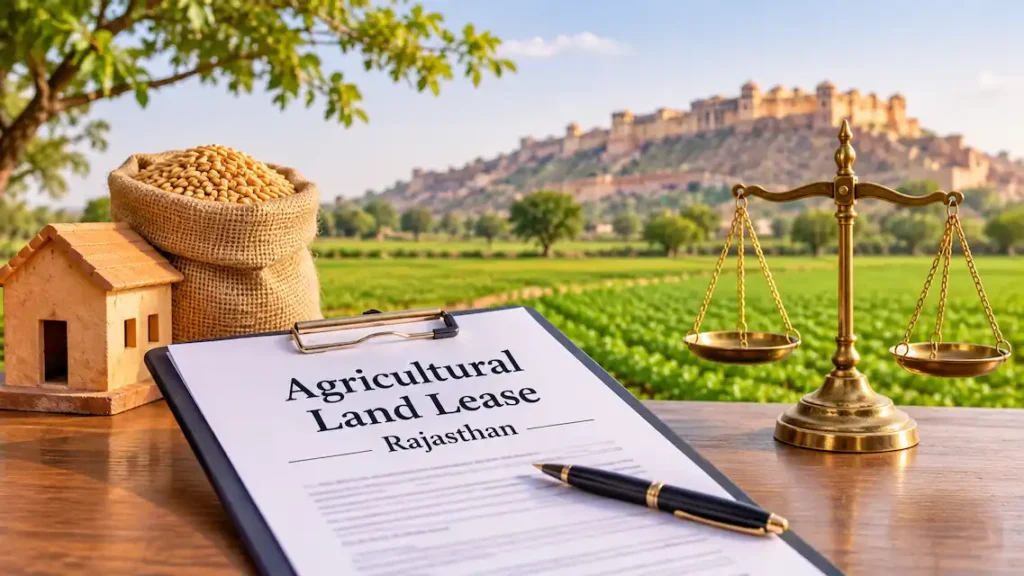
People are more inclined to admit owning farmland they do not farm than admitting owning farmland they do not live on. Maybe you purchased a plot as an investment. Maybe your family land is in a different location from where you reside. Either way, an oft-recurring question is, can that land yield something while I hold on to it?
Yes it can, but within limits. While a lease of agricultural land in Rajasthan is allowed, how long it can be, who can grant it and the after-effects of poor documentation is governed by the Rajasthan Tenancy Act and rules. Violating these laws can turn an otherwise simple lease agreement into a long legal tangle.
Is Leasing Agricultural Land in Rajasthan Legal?
Yes, it is legal. Rajasthan Tenancy Act, 1955 provides that a khudkasht landholder can lease out land and a tenant can sublet. However, in both the cases, the provisions of the Act are to be complied with.
The majority of individual land holdings in farmlands of Rajasthan is in the nature of khatedari tenancy. Verify your status with the help of jamabandi record. Your status determines the rules that will govern the lease of agricultural land.
What Are the Agricultural Land Lease Rules in Rajasthan?
The main agricultural land lease rules in Rajasthan come from Sections 45, 46 and 46A of the amended Tenancy Act 2011. Here is a simplified version of these rules:
5 year leases. Landlords or khatedars cannot let or sublet land for a period greater than five years at a time.
2 year wait. After the expiration of a lease, no new lease of the same land can be granted for at least two years.
Longer leases for agribusiness. Leases for farming, inter alia, related to approved agro-processing or agribusiness, can be granted for a period of up to 15 years, and can be extended for a further period of 15 years.
Gair khatedar tenants. These tenants can sublet for a period of not more than one year.
Scheduled Castes and Scheduled Tribes owners. These owners can only sublet to members of the same Castes and Tribes.
Exceptions. Widows, minors and unmarried/divorced women, members of the armed forces, prisoners, the physically challenged, and students up to the age of 25 are not bound to the five year rule.
| Situation | Term | Condition |
|---|---|---|
| Standard lease by landowner or khatedar | 5 years at a time | 2 year gap before another lease on the same land |
| Approved Agro Processing or Agri Business Use | 15 years, extendable by 15 years | Requires State Government approval |
| Sublet by a gair khatedar tenant | 1 year | Cannot sublet for longer |
| Widow, minor, armed forces member and similar cases | Limits in section 45 do not apply | Lease ends within 2 years of the lessor’s death or loss of eligibility |
These limits are part of the agricultural land lease rules in Rajasthan and apply to every Agricultural Land Lease in Rajasthan. Therefore, please confirm the text from the latest local Advocate before signing the lease.
What Should an Agricultural Land Lease Agreement Include?
A verbal agreement is the biggest mistake landowners make. A written agricultural land lease agreement protects both sides and gives you proof in case there is a dispute. Most agreements cover the following:
- Full names, addresses and ID details of both the lessor and lessee.
- Jamabandi details, land boundaries and area, khasra number.
- Lease start and end date.
- Rent, how it will be paid, when it is due and if there will be an increase annually.
- Permitted use of the land.
- Who will maintain the electricity and water connection, borewell, fences and farm structures.
- How the land will be returned and the condition it will be in.
- Notice period and how disputes will be resolved.
- Registration
Agricultural land lease agreements for a period more than one year require registration as per the Registration Act, 1908. Stamp duty applies to effect registration at the sub registrar’s office. Costs vary depending on the state and year and the best bet is to check with your local sub registrar’s office. Rent agreements should always be effected by a banking mode of payment to protect the lessors interest. A clear, written payment trail serves as evidence should a dispute arise.
What Is the Agricultural Land Lease Rate per Acre in Rajasthan?
The government has not fixed any rate for lease of private farmland. Each lease agreement is a private agreement, and the lease rate is determined based on several factors including soil type, location, water availability and access, and how many farmers want land in that area.
A single field report provides some helpful information. Farmers in the Shekhawati belt of Sikar district said that in 2022, land rent for vegetable farming was ₹4,000 to ₹5,000 per bigha. It increased to ₹6,000 to ₹7,000 per bigha in 2023. As per the same report, one hectare is about 3.95 bighas, and hence, 1 acre is about 1.6 bighas. Thus, ₹9,600 to ₹11,200 per acre is the land rent in that area.
Please don’t take this number blindly. Sikar is a vegetable lease belt and Alwar or Naugaon can price very differently. Also, the size of a bigha varies in Rajasthan, so convert using the local measure in your area.
Some factors that make the rate go up or down:
Availability of water. Land with a functional borewell or land with a canal earns more.
Size of land. Tenants prefer larger land parcels.
Crops. Farmers growing vegetables can pay more than farmers growing wheat or mustard.
Access to roads. Land which can be accessed easily by a tractor or pickup earns more.
The best way to fix the price of your land is to talk to 3 to 4 local farmers and one local dealer. A higher agricultural land lease rate per acre will be useful only if a reliable tenant will pay that.
How Much Income from Leasing Agricultural Land Can You Expect?
We will do a simple example here. Let’s say you leased 5 acres at ₹10,000 per acre per year. Your expected income would be ₹50,000 in that year. Again, this is a simple example and your expected income may be higher or lower.
In a report for Sikar, a lessee approximated that the selling price of wheat per bigha is around ₹13,000 leaving out costs. Owner’s rent is ₹6,000 to ₹7,000 per bigha, and is devoid of the risk of seed, labor and weather. This is the primary reason why agricultural land leasing is attractive to the landless who wish to farm.
However, consider this realistically. Income from leasing agricultural land is expected to be lower as compared to the potential appreciation of the land. Renting your land should never bring you a negative title. For the land in question, the potential appreciation of the land outweighs the income from leasing. Consider rent as a way to recoup expenses for fencing, maintenance and caretaker costs while the land is in use.
Is Income from Leasing Agricultural Land Taxable?
In most cases, the answer will be no. Income from agricultural land leasing is considered agricultural income which is exempt from tax under Section 10(1) of the Income Tax Act, 1961. The Income Tax Act, 2025 came into effect on 1 April 2026 and renumbers many sections, however, agricultural income still includes rent or revenue from agricultural land.
Two important things to keep in mind:
The land has to be used for farming. If a tenant uses it as a warehouse or for housing, the rent can become taxable.
Agricultural income can be taken into account while calculating tax on your other income. So a short consultation with a chartered accountant is useful.
Selling the land is a different ball game, because in that case we need to look at capital gains tax. We have discussed this in detail in our capital gains tax on agricultural land in Rajasthan article.
What Risks Should Landowners Plan For?
Most problems with tenants can be prevented and the following should be watched:
Tenants overstaying. Tenancy laws in Rajasthan have historically provided protections for long standing tenants. Take possession on time.
Soil depletion. The Sikar report mentions the worry of long term pesticide use on rented vegetable farms. At the time of handing over the possession, note the condition of the soil and include an agreement to not use certain chemicals.
Land misuse. Ban construction and dumping in an agreement.
Unpaid rent. Take an advance and keep a record of all payments.
Unclear title. Check for pending cases and confirm mutation and jamabandi before leasing. Our article on mutation and our legal verification article can be helpful here.
Most worries disappear with a clean agricultural land lease agreement, with an exit clause.
Is Leasing an Option for Small Farm Plots Near Naugaon?
It depends on the plot. A small farm plot in a gated layout is often non-family owned, and tenant farmers are looking for larger plots. In your case, it is best to check your sale deed and layout rules to see if there are any restrictions. If these rules do not prevent you from leasing the land, and you are within the restrictions of the law, then an agricultural land lease in Rajasthan is a good option.
For smaller plots, a shorter, seasonal lease would work better than a multi-year lease. Another option is to approach the nearby land owners to lease a bigger piece of land, which is usually preferred by tenants. Maintain the land for its agricultural use and keep the documents clean.
Final Thoughts
An agricultural land lease in Rajasthan gives a guaranteed rent and allows you to avoid the burden of taking care of the land yourself. The laws are strict, so you have to abide by the five year rule, and draw up an agricultural land lease agreement correctly. Price the lease according to the going rate, and understand the income from leasing agricultural land you may expect to generate. Only then can you rely on it.
FAQs- Agricultural Land Lease
Yes. The Rajasthan Tenancy Act, 1955 permits landowners to lease land and tenants to sublease, within certain restrictions. Therefore, leasing agricultural land in Rajasthan is legal if the restrictions, term limits and requirements are complied with. Check your jamabandi record first to find out which rules will be applicable to you.
In Rajasthan, agricultural land can be leased for a maximum period of five years and a second successive lease cannot be given for the same land within a period of two years. A continuous agribusiness use can extend to a period of 15 years. Gair khatedar tenants can sublet for a period of one year only.
An agricultural land lease agreement should contain the names of the lessee and lessor, a description of the land including its khasra number, area and boundaries, the period of lease and the dates of commencement and termination. Other terms that may be included are the rent, the mode of payment, the purpose for which the land may be used, and the condition in which the land must be returned at the termination of the lease. If the lease is for a period of more than one year, it must be registered under the Registration Act, 1908.
There is no prescribed rate, therefore the rate is determined by the market forces of supply and demand. A report by a local newspaper from Sikar in 2023 estimated that the rate was between ₹9,600 to ₹11,200 per acre for a one year lease. Other reports suggest that leases in Alwar are higher and leases in Naugaon are lower.
Income from leasing agricultural land is dependent on your acreage and the local rent. Say 5 acres is rented out at ₹10,000 per acre. That would yield about ₹50,000 per year. Farm land income has the potential to be lucrative, but generally it is less than the appreciation in land value.